Blog

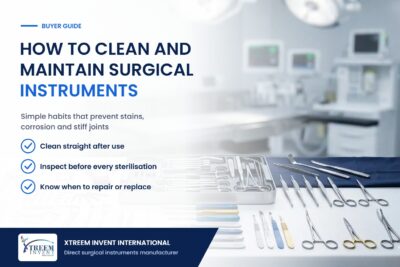
A well-made surgical instrument can last for many years, but only if it is looked after. Most early failures, such as staining, pitting, stiff joints and dull edges, come from handling and cleaning rather than from the steel. This guide covers the habits that protect your instruments. Always follow your facility’s reprocessing protocol and the instructions supplied with each instrument; this article is general guidance only.
Start cleaning straight after use
Blood, tissue and saline left to dry on stainless steel are the main cause of staining and pitting. Wipe instruments during the procedure where possible, and begin cleaning as soon as it ends. Never leave instruments soaking in saline.
Clean before you sterilise
- Open or disassemble every instrument so the solution reaches joints, ratchets and serrations.
- Use a neutral pH detergent made for surgical instruments. Household cleaners and bleach attack the protective surface of the steel.
- Use soft brushes, not steel wool or abrasive pads.
- Rinse thoroughly, ideally with distilled or deionised water, to avoid mineral spots.
- Dry completely before packing. Moisture trapped in a box lock is a common starting point for corrosion.
Inspect every time
Before sterilisation, check each instrument: scissors should cut cleanly to the tip, forceps tips should meet evenly, ratchets should hold and release, and joints should move smoothly. Look for cracks around box locks and for any rough or discoloured areas. Remove damaged instruments from service.
Lubricate moving parts
Use a water-soluble instrument lubricant on joints and ratchets after cleaning. Do not use industrial oils, which can prevent steam from reaching the surface during sterilisation.
Sterilise and store correctly
- Sterilise instruments with ratchets open.
- Do not overload trays, and keep heavy instruments below delicate ones.
- Keep stainless steel separate from instruments made of other metals during cleaning.
- Store in a clean, dry place.
Reading the marks on your instruments
- Brown or orange stains are often deposits from water or other instruments rather than true rust. If the mark wipes away with an eraser and the steel underneath is smooth, it is a stain.
- Pitting under a stain means corrosion has started and the instrument should be assessed.
- Blue or rainbow tints usually come from heat or water quality.
When to repair and when to replace
Sharpening, realignment and refinishing can restore many instruments. Replace any instrument with cracks, deep pitting or joints that no longer hold alignment. If the pattern is no longer sold, it can be remade: see our page on discontinued surgical instruments.
Xtreem Invent International manufactures surgical instruments in Sialkot, Pakistan and ships worldwide. Browse the catalogue or read how to choose a surgical instrument manufacturer.

Chief Executive Officer (CEO)
Zi-Jah Chaudery is the Chief Executive Officer (CEO) at Xtreem Invent, bringing over 20 years of core expertise in the surgical instruments and medical devices manufacturing sector. A visionary leader in international trade and global B2B healthcare exports, he specializes in supply chain management, compliance, and international quality standards. Under his leadership, Xtreem Invent connects premium Pakistani manufacturing with healthcare facilities worldwide.