Blog

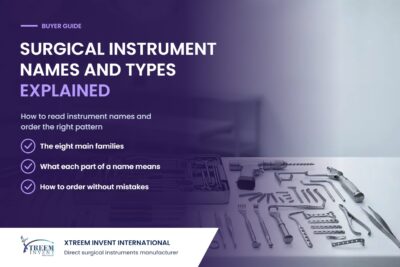
Surgical instruments are named by what they do, and often also by the surgeon who designed the pattern. That is why a catalogue can list dozens of forceps that look similar at first glance. This guide explains the main families of instruments and how to read their names, so you can find and order the right one.
The main families
- Cutting and dissecting: scalpels, scissors, osteotomes, chisels, curettes and bone cutters. They divide or remove tissue and bone.
- Grasping and holding: tissue forceps, dressing forceps, bone holding forceps and needle holders.
- Clamping: hemostatic forceps and vascular clamps, which close with a ratchet to control bleeding or hold tissue.
- Retracting: hand-held and self-retaining retractors, hooks and specula, which hold tissue aside to expose the surgical site.
- Rongeurs and punches: instruments with cupped or punching jaws that bite away bone or tough tissue.
- Elevators: blades used to lift or separate tissue from bone.
- Probes, dilators and cannulas: for exploring, widening or accessing a passage.
- Measuring and guiding: depth gauges, sizers, drill guides and templates used mainly in orthopedic surgery.
How to read an instrument name
Most names combine some of these parts:
- Pattern name: often a surgeon’s name, such as Liston, Cottle or Ruskin. It identifies a specific design.
- Type: forceps, retractor, rongeur, elevator and so on.
- Working end: straight, curved or angled; sharp or blunt; serrated or smooth; the number of prongs or teeth.
- Size: overall length, and sometimes the width of the jaw or blade.
- Action: single or double action on cutters and rongeurs. Double action gives more cutting force for the same hand pressure.
- Material or finish: for example tungsten carbide inserts, often shown by gold handles.
Instruments by specialty
The same families appear in every specialty, in patterns suited to the anatomy: long, strong instruments for orthopedic and spine surgery; fine, delicate ones for plastic surgery and ENT; and specialised specula and dilators for gynecology. Sets group the instruments needed for one procedure in a single tray.
How to order the right instrument
- Give the full pattern name, type, size and working end.
- If you only have the instrument, send a photo with a ruler beside it.
- If you have an old catalogue number from another supplier, include it.
- Say whether you need a single instrument or a complete set.
If the pattern you need is not in any catalogue, it can be made: see custom surgical instruments and discontinued surgical instruments. To see how these families look in practice, browse the Xtreem Invent catalogue.

Chief Executive Officer (CEO)
Zi-Jah Chaudery is the Chief Executive Officer (CEO) at Xtreem Invent, bringing over 20 years of core expertise in the surgical instruments and medical devices manufacturing sector. A visionary leader in international trade and global B2B healthcare exports, he specializes in supply chain management, compliance, and international quality standards. Under his leadership, Xtreem Invent connects premium Pakistani manufacturing with healthcare facilities worldwide.