Blog

The Kerrison rongeur is one of the most used instruments in spine surgery. It removes bone and ligament in small, controlled bites, which makes it essential wherever the surgeon is working close to the spinal cord or nerve roots. This guide explains how a Kerrison rongeur works, which angles and bite sizes are available, and what to check before you buy.
What is a Kerrison rongeur?
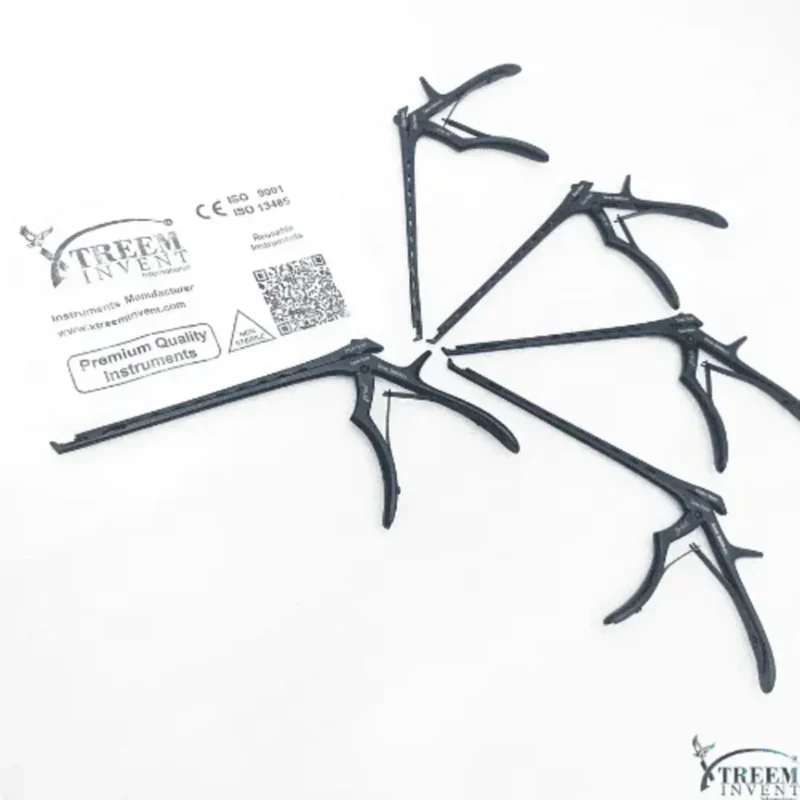
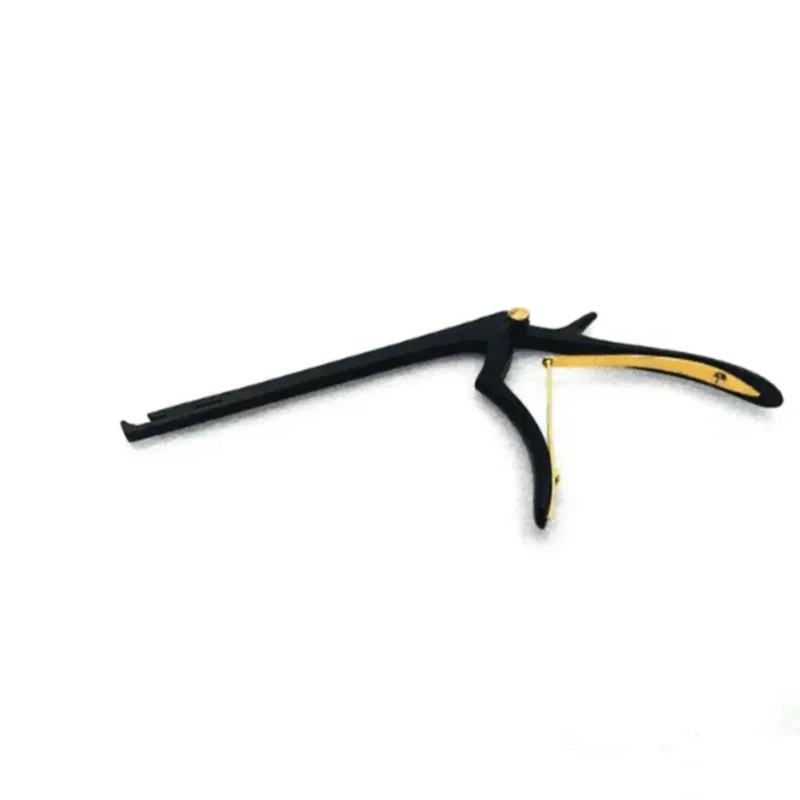
A Kerrison rongeur is a hand-held cutting instrument with a long, slim shaft. At the tip there is a fixed footplate and a sliding cutting bar. The surgeon slips the thin footplate under the edge of the bone or ligament, squeezes the handle, and the cutting bar slides forward to punch out a small piece of tissue. This lets the surgeon remove bone in a precise, measured way.
The instrument is also known as a Kerrison punch or laminectomy punch.
Where Kerrison rongeurs are used
- Laminectomy and laminotomy, removing part of the lamina to relieve pressure on the spinal cord or nerves.
- Foraminotomy, widening the opening where a nerve root leaves the spine.
- Discectomy and spinal fusion, clearing bone and ligament to reach the disc space.
- Ligamentum flavum removal in cervical and lumbar decompression.
- Other procedures where small amounts of bone must be removed in a tight space, including some neurosurgical and orthopedic procedures.
Kerrison rongeur angles, bite sizes and lengths
Kerrison rongeurs come in many combinations. These are the main options you will see in a catalogue:
| Option | Common choices | What it changes |
|---|---|---|
| Tip angle | 40° and 90° (most common), also 110° and 130° | How the jaw reaches the bone. Steeper angles help the surgeon work around corners. |
| Bite direction | Up-biting or down-biting | Whether the jaw cuts upward or downward relative to the shaft. |
| Bite width | 1mm to 6mm | How much bone is removed with each bite. Small bites for delicate work, larger bites to remove bone faster. |
| Shaft length | About 7 to 11 inches | Reach. Longer shafts for deeper lumbar work, shorter shafts for cervical work. |
| Footplate | Standard or thin | A thin footplate slides into tighter spaces with less pressure on the tissue underneath. |
| Ejector | With or without | An ejector pushes the bone fragment out of the jaw so it does not have to be cleared by hand. |
Detachable or non-detachable?
A non-detachable Kerrison opens for cleaning but stays in one piece. A detachable Kerrison separates into two parts, so the sterile processing team can reach every surface inside the shaft. Detachable designs are easier to clean thoroughly, which is why many hospitals prefer them.
How to choose the right Kerrison rongeur
- Start with the procedure. Cervical work usually needs smaller bites and shorter shafts. Lumbar work often uses larger bites and longer shafts.
- Choose the angle. A 40° up-biting Kerrison is the usual all-round choice. Add 90° or 130° patterns if your surgeons need to reach around corners.
- Build a range of bite sizes. Most spine trays carry several widths, for example 2mm, 3mm, 4mm and 5mm, so the surgeon can switch between fine and fast bone removal.
- Check the footplate. Thin footplates help in tight spaces where every millimetre counts.
- Think about cleaning. Detachable designs and ejectors make reprocessing easier and faster.
- Check build quality. Look for a sharp, square cutting edge, a smooth sliding action and a handle that springs back cleanly to the open position.
Care and maintenance
- Wipe and flush the instrument as soon as possible after use, before blood and tissue dry inside the shaft.
- Open or disassemble it fully for cleaning, and follow your facility’s reprocessing procedures for steam sterilization.
- Check the cutting edge and footplate before every use. A dull or chipped edge tears tissue instead of cutting it.
- Lubricate the moving parts with an instrument lubricant suitable for steam sterilization.
- Never use a Kerrison rongeur to cut wire or pins, or twist it while biting. This damages the jaw and the sliding bar.
Kerrison rongeurs from Xtreem Invent
We manufacture Kerrison rongeurs in our own factory in Sialkot, Pakistan, and supply hospitals, surgery centers and distributors in the USA and worldwide. Our range includes the laminectomy Kerrison rongeur set with five rongeurs and the detachable Kerrison rongeur. You will find more spine instruments in our spine surgery instruments range.
Need a specific angle, bite size or shaft length? We make Kerrison rongeurs to order as custom instruments, and distributors can order them under their own brand through our OEM and private label service.
Frequently asked questions
What is the difference between a Kerrison rongeur and a bone rongeur?
A standard bone rongeur has two cupped jaws that close together like pliers. A Kerrison has a long shaft, a footplate and a sliding cutting bar, so it can bite bone in narrow, deep spaces such as the spinal canal.
What is the most common Kerrison rongeur angle?
The 40° up-biting Kerrison is the most common, followed by the 90° pattern.
What bite sizes should a spine set include?
Most spine sets include several widths between 1mm and 6mm, covering small, medium and large bites so the surgeon can move from fine work to faster bone removal.
Do you ship Kerrison rongeurs to the USA?
Yes. Catalogue items are delivered in 15 to 25 working days, not counting holidays. Shipping is a flat $49 per order and free on orders over $349.99.
Have a question or need a quote? Contact our team or send us your instrument list.

Chief Executive Officer (CEO)
Zi-Jah Chaudery is the Chief Executive Officer (CEO) at Xtreem Invent, bringing over 20 years of core expertise in the surgical instruments and medical devices manufacturing sector. A visionary leader in international trade and global B2B healthcare exports, he specializes in supply chain management, compliance, and international quality standards. Under his leadership, Xtreem Invent connects premium Pakistani manufacturing with healthcare facilities worldwide.