Blog

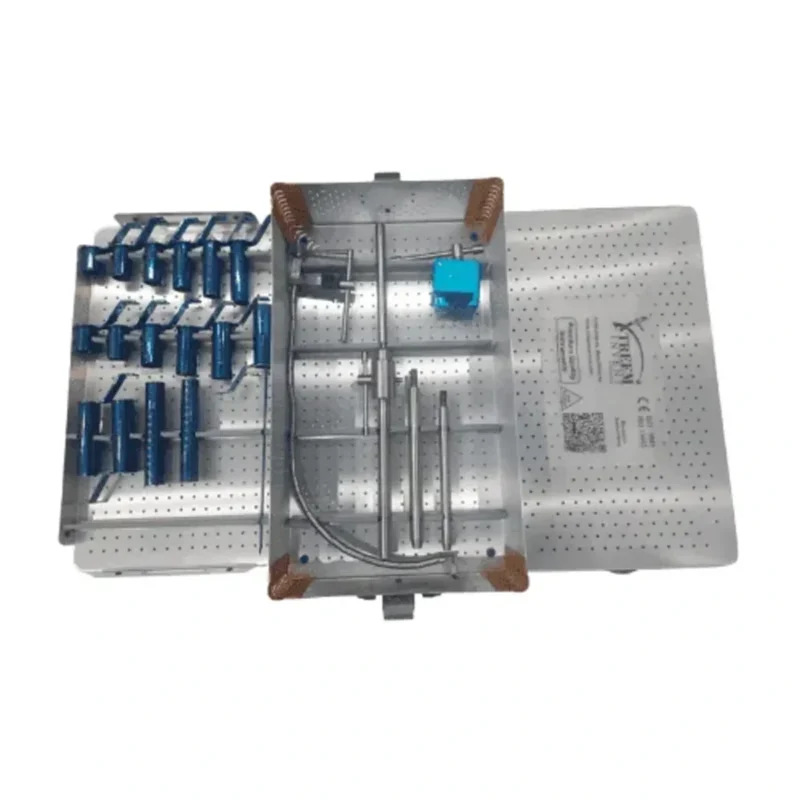
Spine surgery relies on a core set of hand instruments that let the surgeon open a path to the spine, remove bone and disc safely, and protect the nerves. This guide explains the main spine surgery instruments by group, what each one does, and how to build a set for open and minimally invasive (MIS) procedures.
Spine surgery instruments by group
| Group | Common patterns | What they do |
|---|---|---|
| Retractors | McCulloch, Taylor, tubular (MIS) and radiolucent retractors | Hold the muscles apart to expose the spine. Tubular retractors work through a small incision. |
| Elevators | Cobb, periosteal elevators | Lift muscle and soft tissue off the spinous processes and laminae. |
| Rongeurs | Kerrison, pituitary, Leksell | Bite away bone, ligament and disc material in small, controlled pieces. |
| Curettes | Straight, angled and reverse-angled spinal curettes | Scrape bone, cartilage and disc material, for example when preparing the disc space for fusion. |
| Dissectors and probes | Penfield dissectors, nerve hooks and probes | Separate and gently move nerves and dura, and feel for remaining fragments. |
| Distraction and spreaders | Caspar distraction sets, lamina spreaders | Open the space between vertebrae to give access and restore height. |
| Rod and implant instruments | Rod holders, benders and reducers | Hold and place the rods and screws used in spinal fusion. |
Open versus minimally invasive spine surgery
In open surgery, the surgeon works through a longer incision and uses self-retaining retractors such as the McCulloch system. Minimally invasive surgery uses a tubular retractor placed through a small incision, often with radiolucent parts so the X-ray image is not blocked. MIS cases need instruments with longer, slimmer shafts and often bayonet-shaped handles, so the surgeon’s hand stays out of the line of sight.
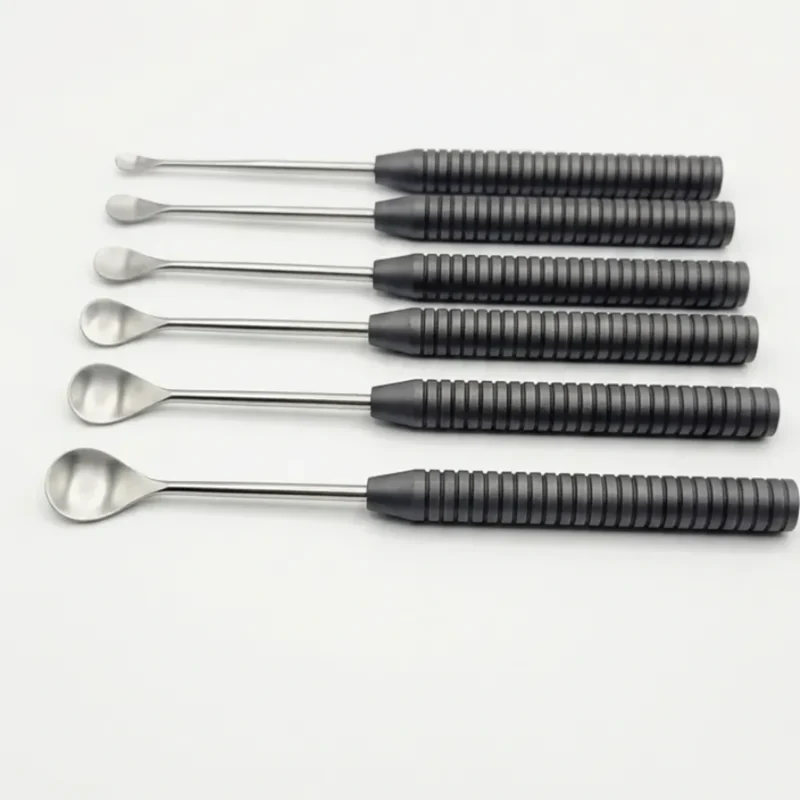
Key instruments explained
Kerrison rongeurs
The workhorse of decompression surgery. A Kerrison has a long shaft and a thin footplate that slips under the edge of the bone before each bite. Read our Kerrison rongeur guide for angles and bite sizes.
Pituitary rongeurs
Used in discectomy to remove disc material. They come straight, up-biting and down-biting, in a range of cup sizes.
Cobb elevators
Broad, strong elevators used to strip muscle from the bone at the start of a posterior approach. Most sets include several widths.
Penfield dissectors
Double-ended dissectors used to separate and protect the dura and nerve roots. They are numbered by shape, from 1 to 5.
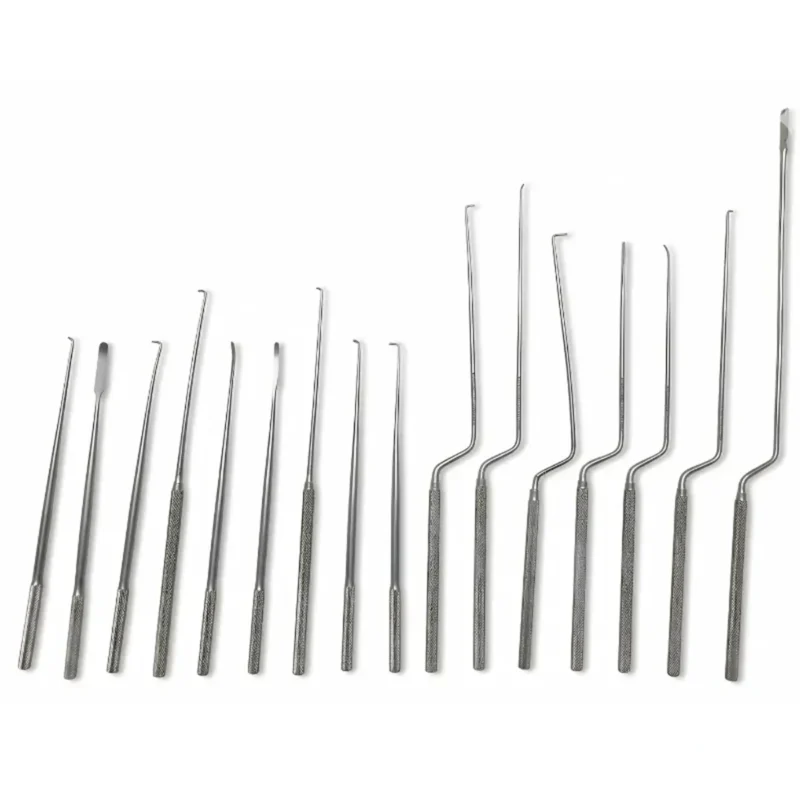
How to build a spine surgery set
- Match the procedure. A microdiscectomy set is smaller than a fusion set. Cervical work needs shorter, finer instruments than lumbar work.
- Cover each step: exposure (retractors, elevators), decompression (Kerrison and pituitary rongeurs, curettes), protection (dissectors, nerve hooks) and, for fusion, distraction and rod instruments.
- Choose a range of sizes for rongeurs and curettes so the surgeon can move from fine to fast work.
- Plan for MIS if your surgeons use tubular retractors: add bayonet and long-shaft patterns.
- Check build quality: sharp, square cutting edges, smooth joints and handles that suit long procedures.
Spine surgery instruments from Xtreem Invent
We manufacture spine surgery instruments in our own factory in Sialkot, Pakistan, and supply hospitals, surgery centers and distributors in the USA and worldwide. Our range includes the laminectomy Kerrison rongeur set, the Cobb elevator set, the microdiscectomy instrument set, cervical curettes, the Caspar vertebral body distraction set, the McCulloch lumbar retractor, the MIS tubular retractor system and radiolucent retractors. See all spine surgery instruments.
We also remake spine retractors and instruments that are no longer produced. See our discontinued instruments and custom instruments services, or our OEM and private label service for distributors.
Frequently asked questions
What instruments are used in a laminectomy?
A typical laminectomy uses retractors, Cobb elevators, Kerrison rongeurs, curettes, Penfield dissectors and nerve hooks, plus pituitary rongeurs if disc material is removed.
What is the difference between open and MIS spine instruments?
MIS instruments are longer and slimmer, often with bayonet handles, so they work through a tubular retractor. Open instruments are shorter and sturdier.
Can you supply a complete spine set to my list?
Yes. Send us your instrument list and we will quote the complete set.
Do you ship spine instruments to the USA?
Yes. Catalogue items are delivered in 15 to 25 working days, not counting holidays. Shipping is a flat $49 per order and free on orders over $349.99.
Have a question or need a quote? Contact our team.

Chief Executive Officer (CEO)
Zi-Jah Chaudery is the Chief Executive Officer (CEO) at Xtreem Invent, bringing over 20 years of core expertise in the surgical instruments and medical devices manufacturing sector. A visionary leader in international trade and global B2B healthcare exports, he specializes in supply chain management, compliance, and international quality standards. Under his leadership, Xtreem Invent connects premium Pakistani manufacturing with healthcare facilities worldwide.