Blog

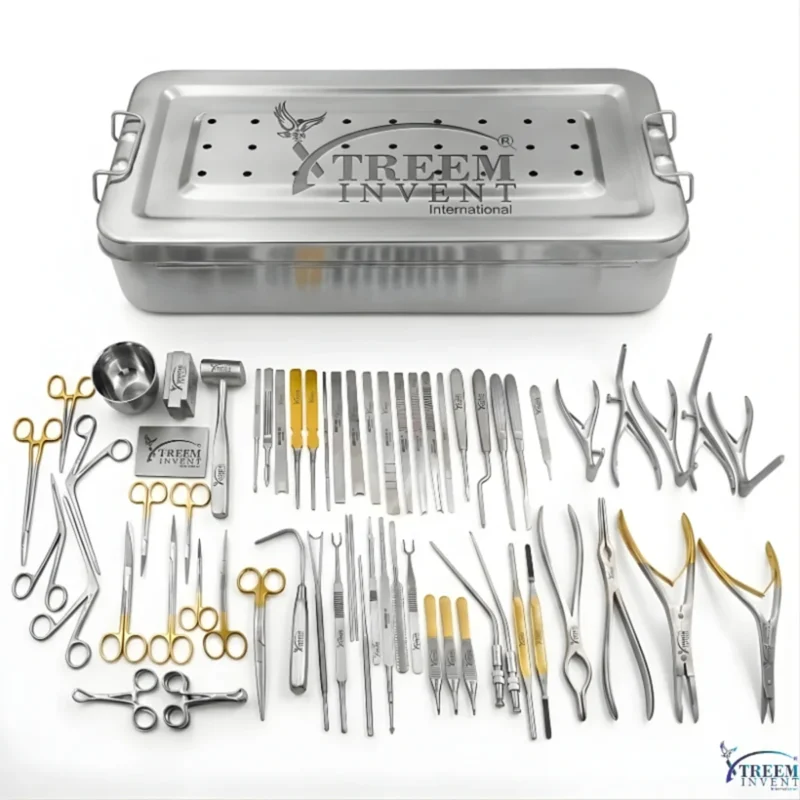
Rhinoplasty is one of the most instrument-heavy procedures in plastic surgery. A typical tray holds dozens of patterns, each with a specific job: lifting the nasal skin, cutting cartilage, filing bone or straightening the septum. This guide explains the main rhinoplasty instruments by group, what each one does, and how to build a set that suits your surgeons.
Rhinoplasty instruments by group
| Group | Common patterns | What they do |
|---|---|---|
| Nasal retractors and hooks | Aufricht, Converse, Cottle retractors, single and double skin hooks | Lift and hold the nasal skin so the surgeon can see the bony and cartilaginous dorsum. |
| Nasal specula | Killian, Cottle, Vienna | Open the nostril so the surgeon can see and work inside the nose. |
| Elevators | Cottle, Joseph, Freer | Lift the lining (perichondrium and periosteum) and soft tissue off cartilage and bone. |
| Scissors and knives | Fomon, Joseph, Caplan septum scissors, Joseph knives | Cut and free soft tissue, cartilage and septum. |
| Rasps | Fomon, Aufricht | File down the bony hump on the bridge of the nose a little at a time. |
| Osteotomes and chisels | Rubin, Sheehan, guarded osteotomes, Cottle chisels | Cut the nasal bones, for example to narrow the nose or remove a hump. |
| Septum and nasal bone forceps | Walsham, Asch, Jansen-Middleton, Rowland | Reposition and straighten the nasal bones and septum, or cut septal cartilage and bone. |
| Dressing and bayonet forceps | Adson-Brown, Lucae and Jansen bayonet forceps | Hold delicate tissue and place packing or splints inside the nose. |
Retractors and specula: seeing the field
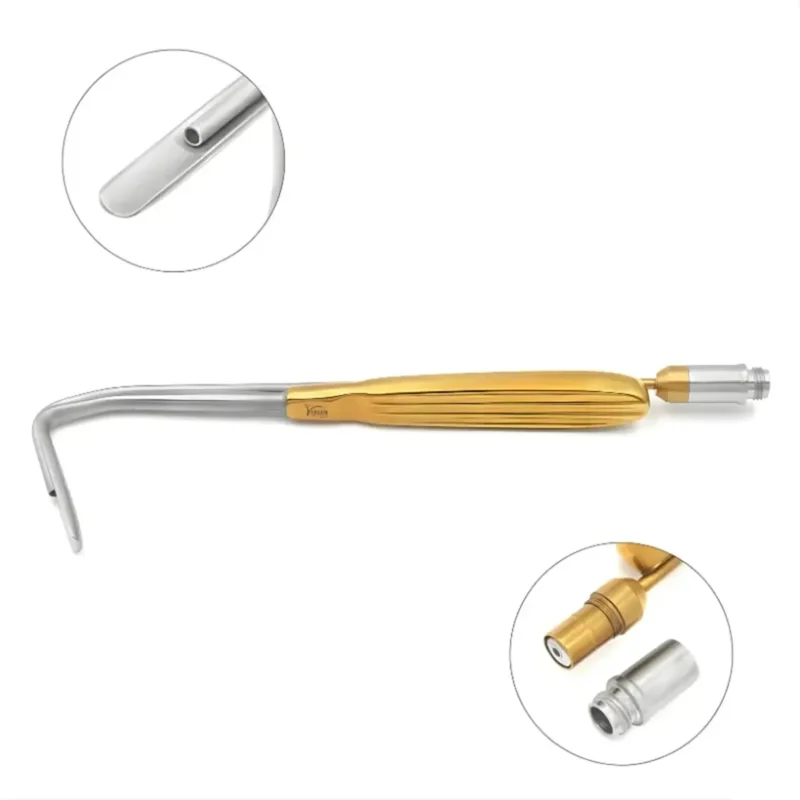
Good exposure comes first. The Aufricht retractor has a wide, smooth blade that lifts the nasal skin off the dorsum, and is found in almost every rhinoplasty set. The Converse retractor and skin hooks hold the alar rims and skin edges, while a Killian or Cottle speculum opens the nostril for work inside the nose. Some Aufricht retractors come with a fiber optic light or a suction channel, which helps in a deep, narrow field.
Rasps and osteotomes: shaping the bone
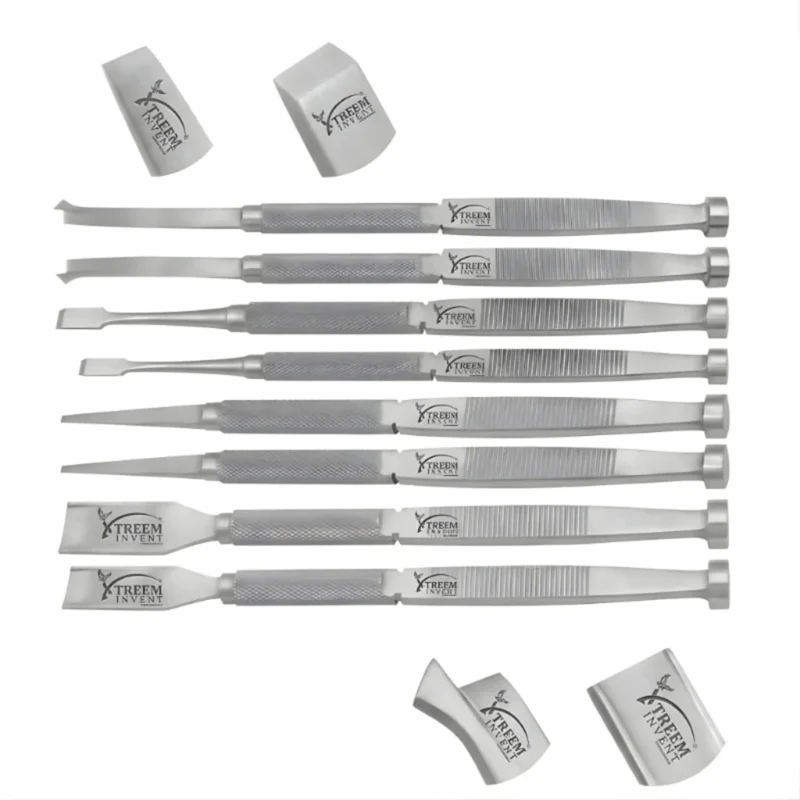
To lower a bony hump, surgeons use either a rasp or an osteotome. A rasp files bone away gradually and gives fine control. An osteotome removes bone faster, but it is easier to take away too much, so many surgeons combine the two. Osteotomes are also used to cut the side walls of the nose when narrowing it. Rasps with tungsten carbide teeth stay sharp for longer.
Septum instruments
Many rhinoplasties include work on the septum. Cottle elevators lift the lining off the septal cartilage, Jansen-Middleton forceps cut and remove septal cartilage and bone, and Walsham and Asch forceps reposition and straighten the nasal bones and septum.
What about preservation rhinoplasty?
Preservation rhinoplasty aims to keep the natural bridge of the nose and lower it instead of removing it. It relies on fine, precise instruments, so many surgeons keep a dedicated set for it alongside their standard tray.
How to build a rhinoplasty set
- Start with the core: retractors and hooks, specula, elevators, scissors, rasps, osteotomes and septum forceps.
- Choose the set size by caseload. A compact set covers routine cases. Busy practices and teaching hospitals often prefer a large set with several sizes of each pattern.
- Get a range of osteotome widths and both straight and curved patterns.
- Check the cutting edges. Rasps should have even, sharp teeth. Osteotomes and scissors should be sharp right to the tip.
- Think about extras: fiber optic or suction retractors, tungsten carbide inserts and a sterilization tray to keep the set organised.
Care and maintenance
- Clean rasps with a brush straight after use. Bone dust trapped in the teeth is hard to remove once it dries.
- Protect the edges of osteotomes and scissors in the tray, and keep fine tips apart.
- Follow your facility’s reprocessing procedures for steam sterilization.
- Have dull osteotomes and scissors sharpened before they start to crush tissue instead of cutting it.
Rhinoplasty instruments from Xtreem Invent
We manufacture rhinoplasty instruments in our own factory in Sialkot, Pakistan, and supply surgeons, hospitals and distributors in the USA and worldwide. Complete sets include the 12-piece preservation set, the 50-piece rhinoplasty set, the 69-piece complete set and the 82-piece major set. See all rhinoplasty instrument sets.
Single instruments include the Aufricht retractor with fiber optic light, the Aufricht retractor with suction, the Converse nasal retractor, the Fomon double-ended nasal rasp set, nasal osteotomes, Walsham and Asch septum forceps, Jansen-Middleton septum forceps and Caplan septum scissors.
Need a set built to your own list? Send us your instrument list. We also make custom instruments and supply distributors through our OEM and private label service.
Frequently asked questions
What is an Aufricht retractor used for?
It lifts the nasal skin off the bridge of the nose so the surgeon can see and work on the bone and cartilage underneath.
What is the difference between a nasal rasp and an osteotome?
A rasp files bone away a little at a time. An osteotome cuts bone in one pass. Rasps give finer control, while osteotomes are faster.
How many instruments are in a rhinoplasty set?
It varies. Compact sets have around a dozen instruments, while complete sets can have 50 to more than 80 pieces.
Do you ship rhinoplasty instruments to the USA?
Yes. Catalogue items are delivered in 15 to 25 working days, not counting holidays. Shipping is a flat $49 per order and free on orders over $349.99.
Have a question or need a quote? Contact our team.

Chief Executive Officer (CEO)
Zi-Jah Chaudery is the Chief Executive Officer (CEO) at Xtreem Invent, bringing over 20 years of core expertise in the surgical instruments and medical devices manufacturing sector. A visionary leader in international trade and global B2B healthcare exports, he specializes in supply chain management, compliance, and international quality standards. Under his leadership, Xtreem Invent connects premium Pakistani manufacturing with healthcare facilities worldwide.