Blog

A self-retaining retractor holds a wound open by itself. Once it is opened, a ratchet, rack or locking frame keeps the arms or blades apart, so nobody has to hold it. That frees an assistant’s hands and gives steady exposure during long operations. This guide compares the main self-retaining retractor patterns, explains prongs, blades and sizes, and shows how to choose.
Self-retaining retractors compared
| Pattern | How it holds | Sizes and options | Typical use |
|---|---|---|---|
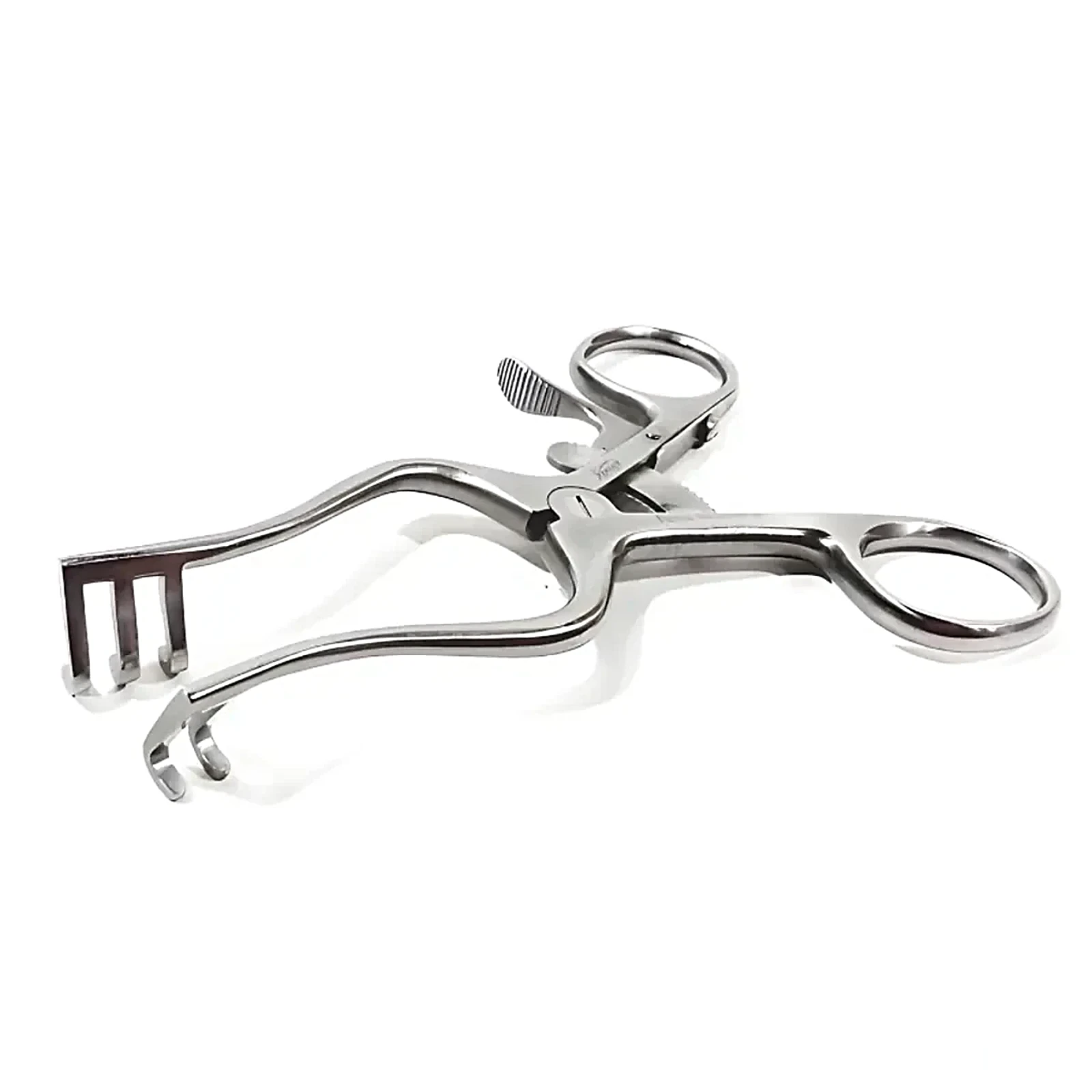
| Baby Weitlaner | Ratchet | 12 to 16 cm; sharp or blunt prongs; 2×3 or 4×3 prongs | Small incisions, such as hand, foot and superficial procedures |
| Mollison | Ratchet | 4×4 or 2×2 prongs | Ear surgery, especially mastoid surgery behind the ear |
| Joll | Self-retaining frame | 2 retaining and 2 pincher blades | General and ENT surgery |
| Balfour | Locking frame | 4 inch; deeper blades on request | Open abdominal and pelvic surgery |
| Alvi-Backmann | Locking system | 33 cm long; 7.9 cm deep when fully bent | Deep exposures in orthopedic, general and plastic surgery |
| Rib distractor | Toothed rack | Small, medium or large | Spreading two ribs to reach the chest |
| Ring retractor system | Ring frame holding several blades | See our ring retractor guide | Complex abdominal and pelvic cases |
Prongs and blades
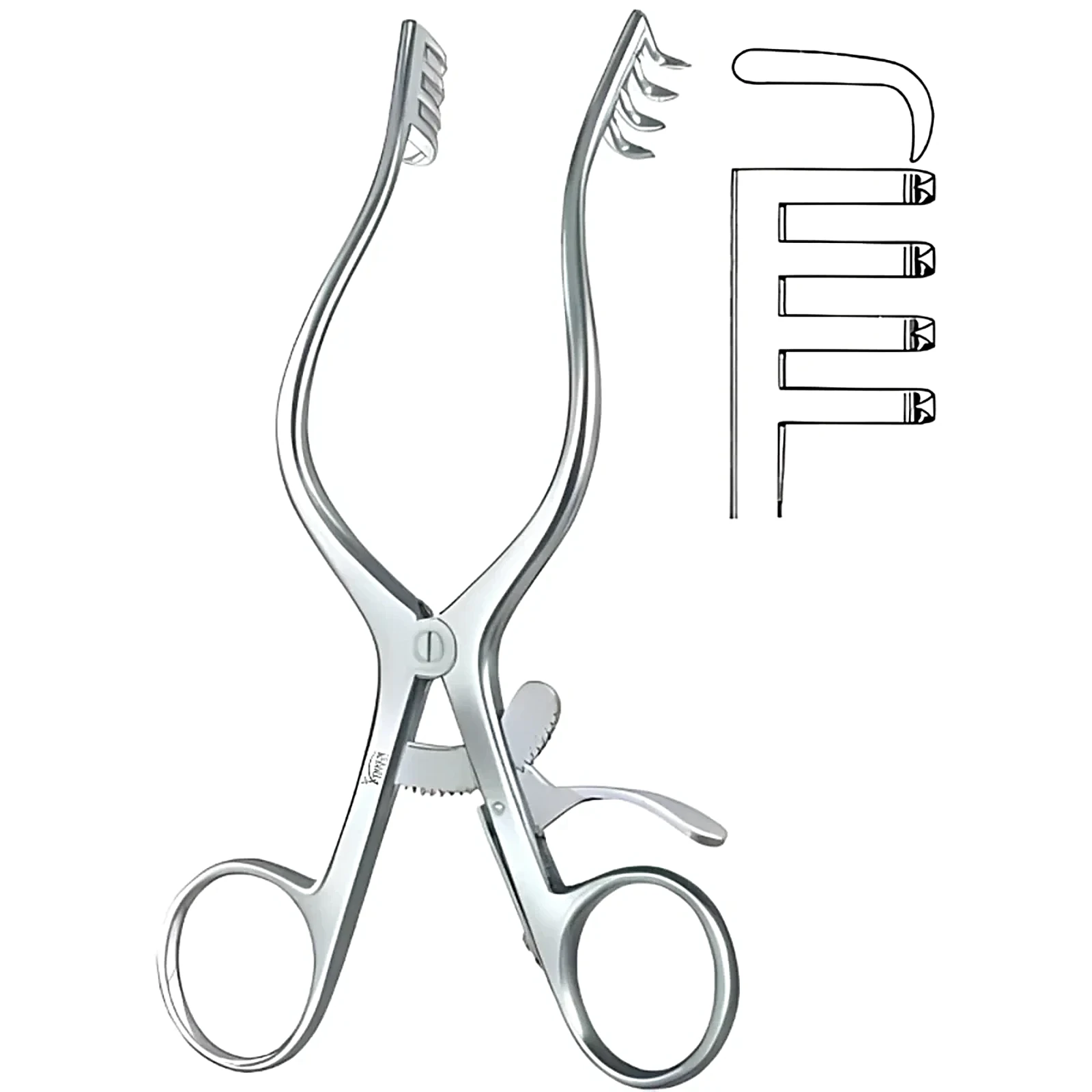
Small self-retaining retractors such as the Weitlaner and Mollison have rake-like prongs. Sharp prongs grip skin and tissue edges firmly; blunt prongs are gentler where vessels or nerves lie near the surface. More prongs, as on the 4×4 Mollison, spread the hold over a wider edge, while fewer prongs, as on the 2×2, take up less space in a small incision. The Joll uses blades instead: retaining blades hook under the wound edge to hold it open, and pincher blades grip the skin flap.
Large retractors for deep wounds
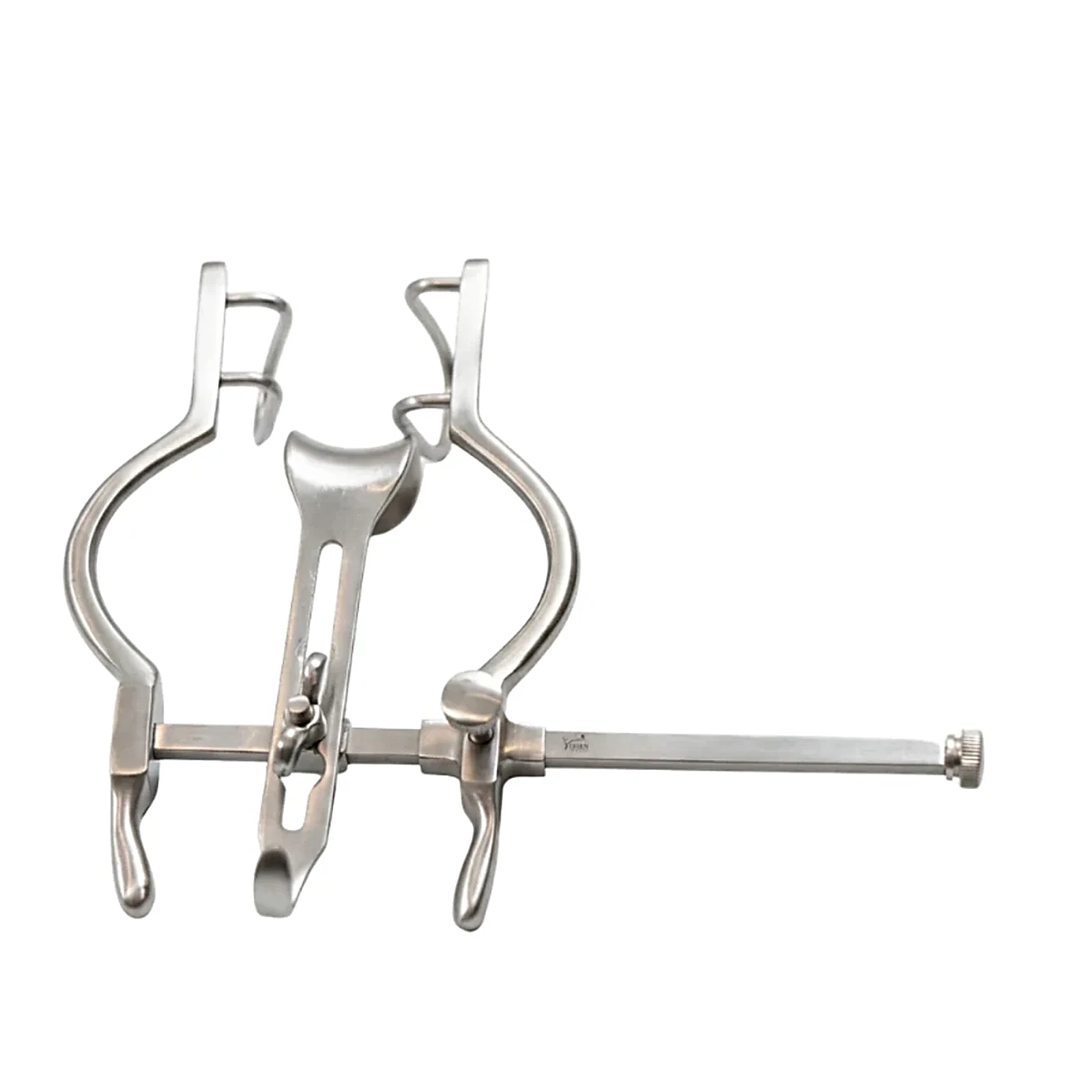
For the abdomen and pelvis, the Balfour frame locks its blades at the chosen opening, and deeper blades can be supplied for larger patients. The Alvi-Backmann is a long 33 cm retractor for deep exposures where a hand-held retractor would tire an assistant. For the chest, the rib distractor spreads two ribs apart on a toothed rack: small suits paediatric patients and limited openings, medium is the general adult size, and large gives the widest opening. For complex abdominal and pelvic cases, a ring retractor system holds several blades around a frame; read our ring retractor guide.
Hand-held retractors we also make
Not every retractor is self-retaining. The Young bifid retractor is held by an assistant; its blade splits into two prongs at the tip so it can straddle a structure, and it is used mainly in urology and pelvic surgery. The modified Kolbel glenoid retractor is used in shoulder replacement to hold tissue away from the glenoid, with a hinge, an ergonomic handle and interchangeable blades of 36 x 68 mm and 20 x 53 mm.
How to choose a self-retaining retractor
- Match the size to the wound: a Baby Weitlaner for small incisions, a Balfour or Alvi-Backmann for deep ones.
- Choose sharp prongs for a firm grip on skin, and blunt prongs near vessels and nerves.
- For ear and ENT surgery, the Mollison and Joll are standard choices.
- Keep more than one size, for example Weitlaners from 12 to 16 cm, or rib distractors in small, medium and large.
- Ask us about spare blades and parts for the model you order.
Care and maintenance
Open the retractor fully for cleaning, and clean ratchets, racks and frame joints carefully, as blood and tissue collect there. Check that the ratchet or rack holds under load and releases cleanly and that the prongs are straight, and sterilise according to your hospital’s protocol.
Self-retaining retractors from Xtreem Invent
We make self-retaining retractors in our own factory in Sialkot, Pakistan, and supply hospitals, surgeons and distributors in the USA and worldwide. See all general surgery instruments, orthopedic surgical instruments and plastic surgery instruments. Need a different size or pattern? See custom instruments.
Frequently asked questions
What is a self-retaining retractor?
A retractor that holds a wound open by itself, using a ratchet, rack or locking frame, so nobody has to hold it.
What is the difference between the Weitlaner and the Mollison?
Both are small ratchet retractors with prongs. The Mollison is used mainly in ear surgery, and the Baby Weitlaner in small incisions such as hand and foot procedures.
Should I choose sharp or blunt prongs?
Sharp prongs grip skin and tissue edges firmly. Blunt prongs are gentler where vessels or nerves lie near the surface.
Do you ship retractors to the USA?
Yes. Catalogue items are delivered in 15 to 25 working days.
Have a question or need a quote? Contact our team.

Chief Executive Officer (CEO)
Zi-Jah Chaudery is the Chief Executive Officer (CEO) at Xtreem Invent, bringing over 20 years of core expertise in the surgical instruments and medical devices manufacturing sector. A visionary leader in international trade and global B2B healthcare exports, he specializes in supply chain management, compliance, and international quality standards. Under his leadership, Xtreem Invent connects premium Pakistani manufacturing with healthcare facilities worldwide.