Blog

Bone is curved, but most fixation plates start out flat or only partly shaped. Before a plate can sit flush on the bone, it often has to be contoured. Orthopedic plate benders are the instruments that do this job. This guide explains the main types of plate benders, how plates are bent, and how to choose the right tools for your trays.
Why plates need to be contoured
A plate that does not match the bone surface can shift the fracture out of position when the screws are tightened. Careful contouring helps the plate sit evenly against the bone, which supports a stable fixation. Contouring matters most with reconstruction plates, which are often used on complex shapes such as the pelvis and the jaw, and with long plates on curved bones.
The three types of bend
Plate contouring is usually described as three kinds of bend, often done in this order:
- In-plane bending: bending the plate sideways, within its own flat plane, to follow a curve when you look at the plate from above.
- Out-of-plane bending: bending the plate up or down so it follows the curve of the bone surface.
- Torquing (twisting): twisting the plate along its long axis so it follows a spiral bone surface.
Many surgeons first shape a soft, flexible template on the bone, then bend the plate to match the template.
Types of orthopedic plate benders
| Bender type | How it works | Best for |
|---|---|---|
| Plate bending pliers | Hand-held pliers that bend the plate between three points of contact. | Quick out-of-plane bends on small and medium plates, close to the operating field. |
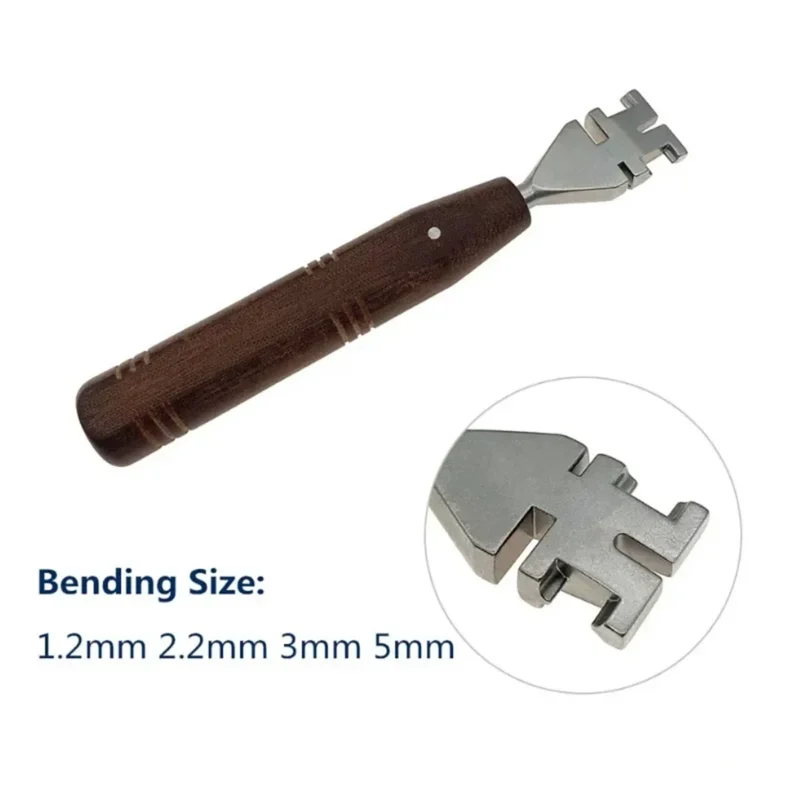
| Bending irons | A pair of bars with slots at the ends. The plate is held in the slots and bent or twisted by moving the irons. | Out-of-plane bends and twisting, especially on longer plates. |
| Bending press | A heavier table-top press with anvils. | Strong, controlled bends on larger and thicker plates. It takes up more space in a tray. |
| In-situ benders | Instruments that bend the plate while it is already positioned on the bone. | Final adjustments without removing the plate, for example on pelvic reconstruction plates. |
| Plate and rod benders | Benders designed to shape both plates and rods. | Practices that contour plates and rods with one instrument. |
How to choose the right plate bender
- Match the bender to the plate size. Pliers and benders are made for a range of plate sizes, from small 2.0mm plates to large reconstruction plates. A bender that is too small will not grip properly, and one that is too large can damage small plates.
- Think about the bends you need. Pliers handle most simple bends. Add bending irons if your surgeons need to twist plates, and a press for very thick plates.
- Check the jaws and anvils. They should be smooth and well finished so they shape the plate without scratching or nicking it.
- Consider tray space. Pliers and irons fit easily in a standard tray. A press is heavier and bulkier.
- Look at the handles. Long handles give more leverage for stiff plates. A comfortable grip helps the surgeon make small, controlled adjustments.
Good bending practice
- Bend gradually. Make several small bends rather than one large bend.
- Avoid bending back and forth. Repeated bending in opposite directions weakens the metal and can lead to plate failure.
- Bend between the holes. Bending across a screw hole can distort it, so the screw no longer seats correctly. This is especially important with locking plates.
- Keep checking the fit against the bone or the template as you go.
- Use pre-shaped plates where available for areas that would need extreme bending.
Plate benders from Xtreem Invent
We manufacture plate bending instruments in our own factory in Sialkot, Pakistan, and supply hospitals, surgery centers and distributors in the USA and worldwide. Our range includes an orthopedic plate bending iron with slots for 1.2mm to 5mm plates, available with a wooden or stainless steel handle, and the orthopedic plate and rod bender in 19cm and 28cm lengths.
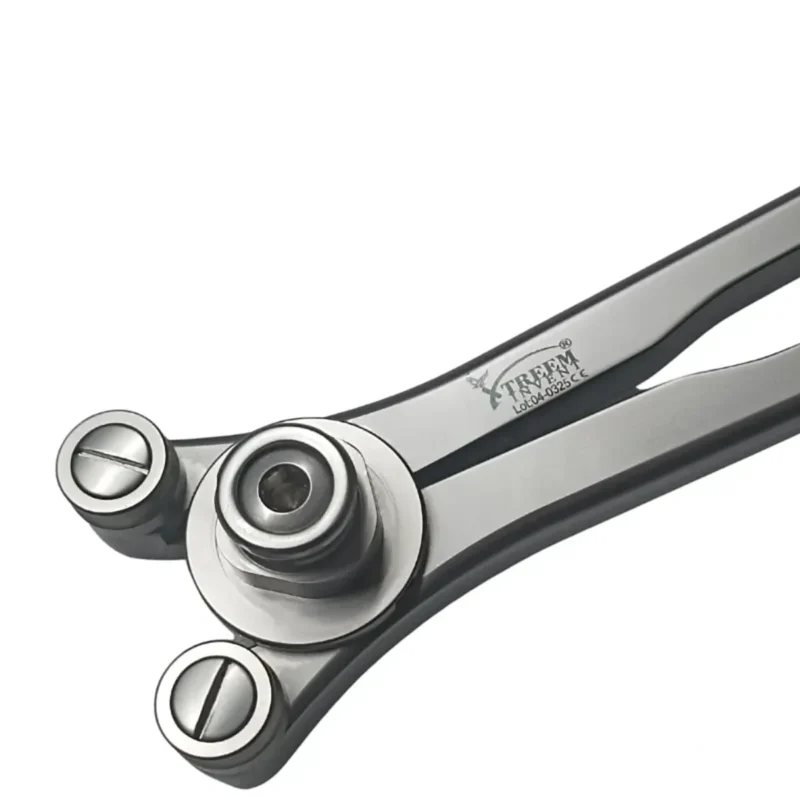
You will find our locking plates and plating systems in the orthopedic implants range, and more trauma instruments in our general orthopedic instruments. Need a bender for a specific plate system? We make custom instruments to order, and distributors can order through our OEM and private label service.
Frequently asked questions
What is the difference between plate bending pliers and bending irons?
Pliers bend the plate with one hand-held tool and are quick for simple bends. Bending irons are used in pairs and give more control for twisting and for bending longer plates.
Can I use one bender for all plate sizes?
Usually not. Benders work best within a range of plate sizes, so most trays include benders matched to the plates they hold.
Can a plate be bent more than once?
Small adjustments are normal, but repeated bending back and forth weakens the plate. Plan the shape with a template and bend gradually.
Do you ship plate benders to the USA?
Yes. Catalogue items are delivered in 15 to 25 working days, not counting holidays. Shipping is a flat $49 per order and free on orders over $349.99.
Have a question or need a quote? Contact our team or send us your instrument list.

Chief Executive Officer (CEO)
Zi-Jah Chaudery is the Chief Executive Officer (CEO) at Xtreem Invent, bringing over 20 years of core expertise in the surgical instruments and medical devices manufacturing sector. A visionary leader in international trade and global B2B healthcare exports, he specializes in supply chain management, compliance, and international quality standards. Under his leadership, Xtreem Invent connects premium Pakistani manufacturing with healthcare facilities worldwide.