Blog

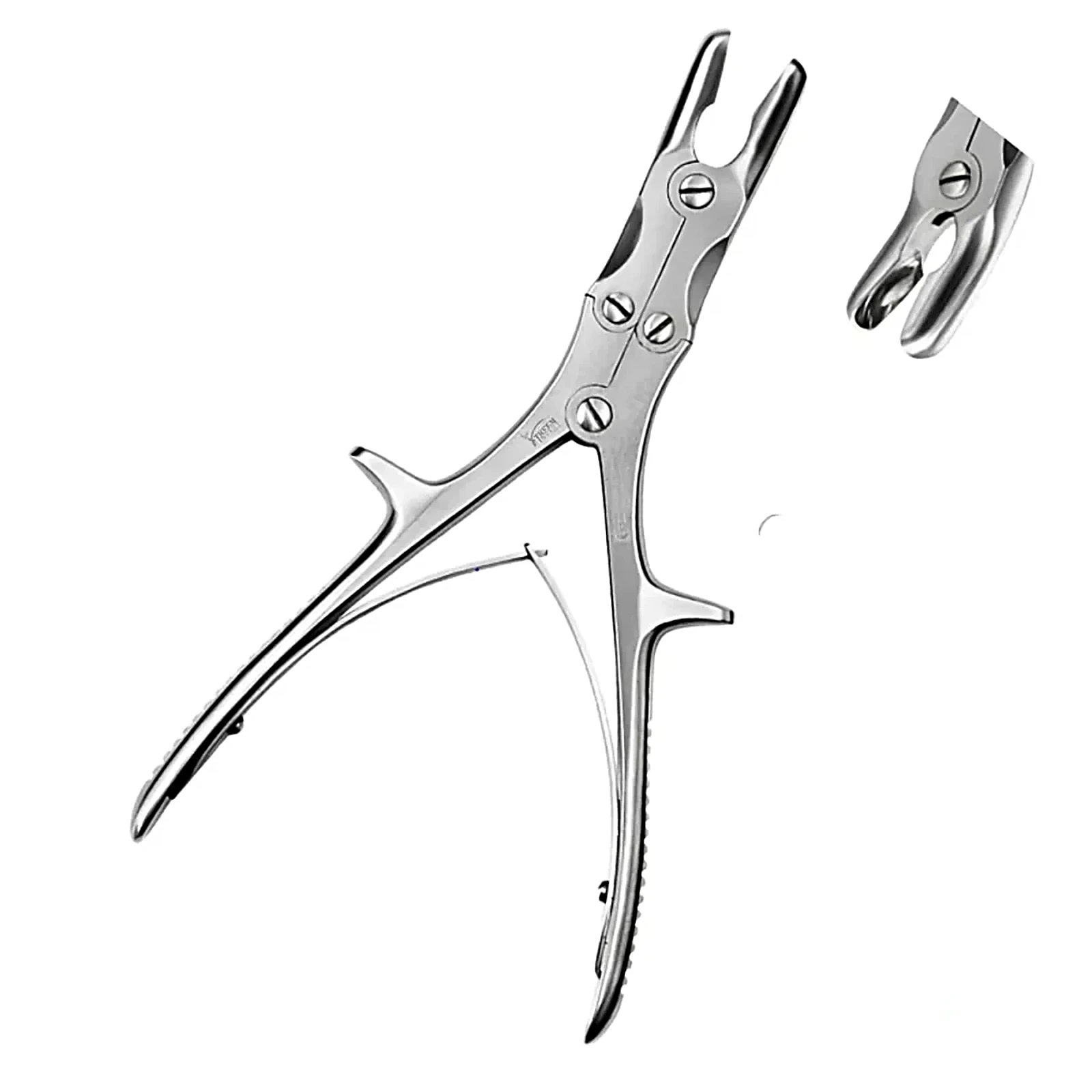
A bone rongeur is a forceps with sharp, cupped jaws that bites away bone a little at a time. Bone cutting forceps, such as the Liston, have straight blades that divide bone in one cut. Both are in almost every orthopedic, spine and neurosurgical tray. This guide compares the main rongeur patterns, explains single and double action, jaw sizes and angles, and shows how to choose.
Bone rongeurs compared
| Pattern | Action | Sizes and options | Typical use |
|---|---|---|---|
| Stille-Luer | Double action | Straight or curved jaw | General bone removal in orthopedic, spine and bone surgery |
| Ruskin | Double action | 18 or 24 cm | A smooth, powerful bite for orthopedic and spinal bone removal |
| Leksell (Leksell-Stille) | Double action | Mouth width 4, 5, 6, 7 or 8 mm | Spine surgery, especially bone at the back of the vertebrae |
| Sypert | Double action | 4, 5, 8 or 12 mm; standard or with teeth | Spinal and neurosurgery |
| Echlin duckbill | Stille-Luer pattern | 22 cm; 2, 3 or 4 mm mouth | Narrow, confined spaces such as in spinal surgery |
| Friedman | Compound action | Delicate cup-shaped jaws | Fine bone work in orthopedic, ENT and neurosurgery |
| Bohler | Small pattern | 6 inch; straight or offset | Hand, foot and other small-bone surgery |
| Sauerbruch | Heavy duty | Bone cutting jaws | Chest surgery, for trimming rib ends |
Single or double action?
A single-action rongeur has one joint, like scissors. A double-action, or compound, rongeur has a second joint that multiplies the force, so hard or thick bone is removed with less hand effort. Most heavy orthopedic and spine rongeurs, such as the Stille-Luer, Ruskin, Leksell and Sypert, are double action. Lighter patterns suit fine work where feel matters more than force.
Jaw size, angle and shape
The jaw width sets how much bone each bite removes. Narrow jaws, such as a 2 mm Echlin duckbill or a 4 mm Sypert or Leksell, take small, careful bites close to nerves. Wider jaws, up to the 12 mm Sypert, clear bone faster where there is room. Curved, offset and angled jaws keep the surgeon’s hand out of the line of sight when the bone lies deep in a wound. The Sypert also comes in a toothed version. Most spine trays carry two or three widths of the Leksell and Sypert.
Kerrison rongeurs for the spine
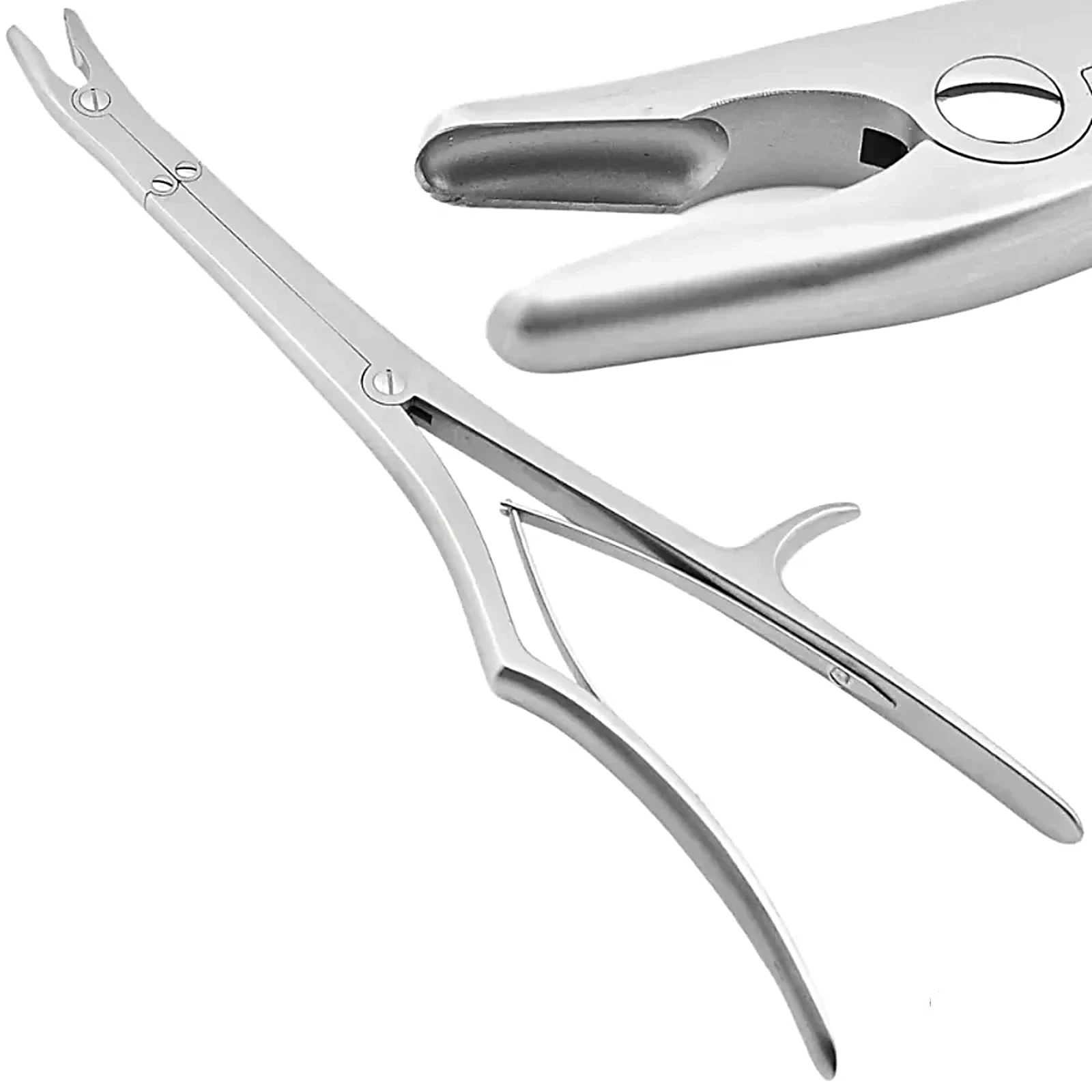
The Kerrison is a different design: a thin footplate slides under the bone at the edge of the spinal canal and bites it away. Our Laminectomy Kerrison Rongeur Set has five Kerrisons with straight, up-biting and down-biting jaws in several widths, and the detachable Kerrison rongeur comes apart so every surface can be cleaned. Read our Kerrison rongeur guide for more.
Bone cutting forceps: Liston Key and Liston Key-Horsley
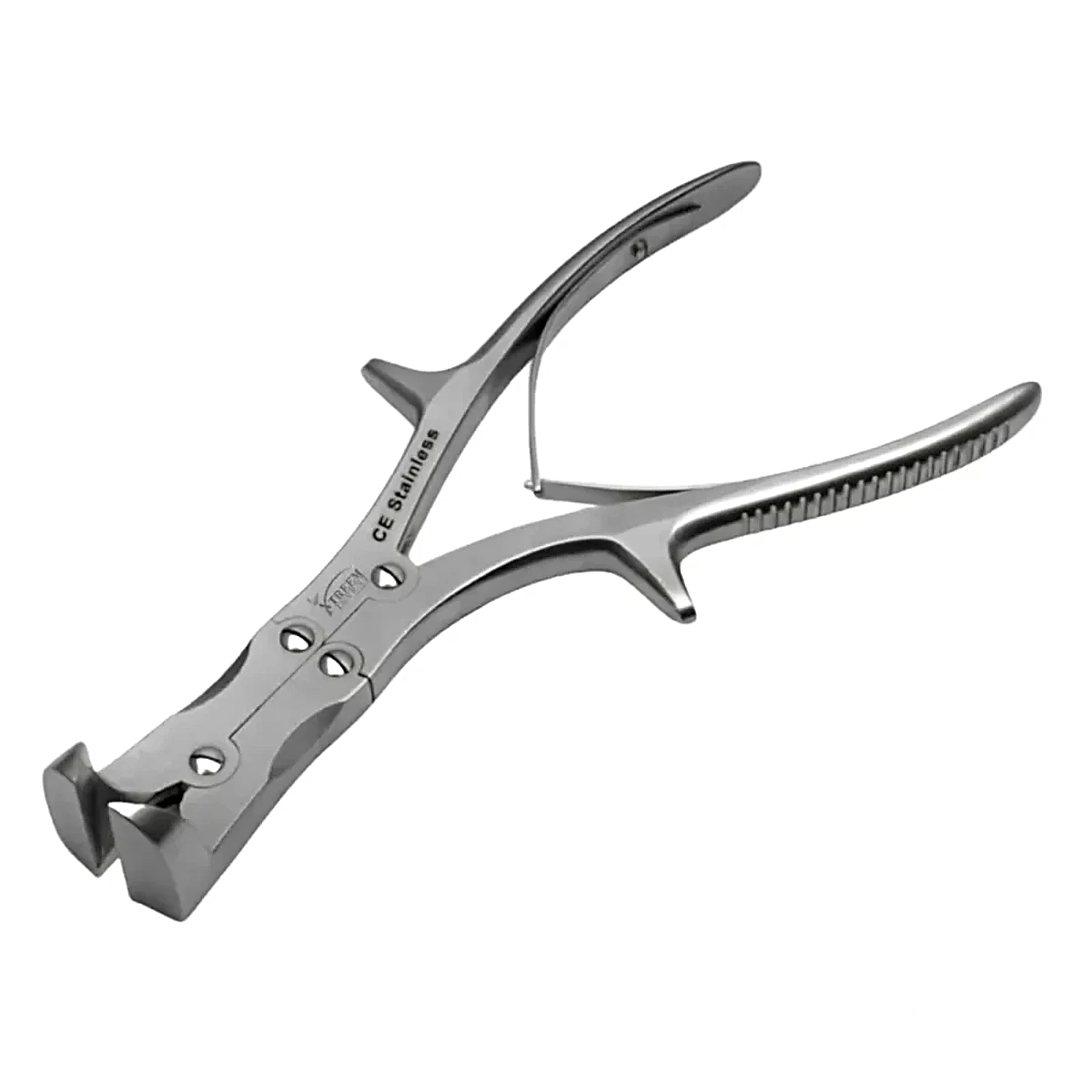
Bone cutting forceps have straight-edged blades that divide bone cleanly in one cut instead of biting it away. The Liston Key bone cutting forceps is 25 cm long, for the leverage larger bones need, and the Liston Key-Horsley forceps is double action for thick bone. Both come with 45 degree blades, which suit most open work where the cutter approaches the bone at a slant, or 90 degree blades, for cutting across a bone in a deep or narrow wound where the handles must stay upright.
How to choose a bone rongeur
- Match the pattern to the work: Stille-Luer or Ruskin for general orthopedic bone removal, Leksell and Sypert for the spine, Friedman and Bohler for fine and small-bone work, and Sauerbruch for rib ends.
- Choose double action for hard or thick bone.
- Pick jaw widths for the space: narrow near nerves, wider where there is room. Spine trays usually carry two or three widths.
- Choose straight, curved, offset or angled jaws for the depth of the wound.
- Add a Liston bone cutter when bone has to be divided rather than trimmed.
Care and maintenance
Bone debris packs into the cups and joints of a rongeur, so clean them straight after surgery with the jaws fully open, brushing the cups and box joints. Lubricate the joints with instrument lubricant, check that the jaws meet evenly and the edges are sharp, and sterilise according to your hospital’s protocol. Rongeur cups and bone cutter blades can be reground when they dull.
Bone rongeurs from Xtreem Invent
We make bone rongeurs and bone cutters in our own factory in Sialkot, Pakistan, and supply hospitals, surgeons and distributors in the USA and worldwide. See all general orthopedic instruments and our orthopedic surgical instruments, or read our orthopedic instruments list and spine surgery instruments guide.
Frequently asked questions
What is a bone rongeur used for?
To remove bone a little at a time with sharp, cupped jaws, for example to trim bone edges, clear bone in spinal surgery or shape bone for a graft or implant.
What is the difference between a rongeur and a bone cutter?
A rongeur bites bone away in small pieces with cupped jaws. A bone cutter such as the Liston has straight blades that divide bone in one cut.
Which rongeurs are used in spine surgery?
The Leksell, Sypert, Echlin duckbill and Kerrison rongeurs are standard in spinal trays, often in two or three widths.
Can rongeurs be resharpened?
Yes. The cups and blades can be reground when they become dull.
Do you ship bone rongeurs to the USA?
Yes. Catalogue items are delivered in 15 to 25 working days.
Have a question or need a quote? Contact our team.

Chief Executive Officer (CEO)
Zi-Jah Chaudery is the Chief Executive Officer (CEO) at Xtreem Invent, bringing over 20 years of core expertise in the surgical instruments and medical devices manufacturing sector. A visionary leader in international trade and global B2B healthcare exports, he specializes in supply chain management, compliance, and international quality standards. Under his leadership, Xtreem Invent connects premium Pakistani manufacturing with healthcare facilities worldwide.