Blog

Two instruments can be made from the same grade of stainless steel and still behave completely differently in theatre. One holds its edge for years; the other goes blunt, springs open at the jaws or snaps at the tip. In most cases the difference is not the steel itself but how it was heat treated. This guide explains, in plain terms, how the heat treatment of stainless steel changes its strength, hardness, toughness and corrosion resistance, and what that means when you buy surgical instruments.
Strength, hardness and toughness are not the same thing
Before looking at furnaces and temperatures, it helps to separate three properties that people often mix up:
- Strength is how much load the steel can carry before it bends permanently (yield strength) or breaks (tensile strength). It matters for retractors, bone-holding forceps and anything that is levered.
- Hardness is resistance to denting and wear, usually measured on the Rockwell C scale (HRC). It decides how long a cutting edge or a set of serrations lasts.
- Toughness is the ability to absorb a shock without cracking. A very hard instrument with poor toughness chips or snaps when it is dropped or twisted.
Heat treatment moves these properties against each other. More hardness usually means less toughness, so the goal is never “as hard as possible” but the right balance for each instrument.
Which stainless steels respond to heat treatment?
Stainless steel is a family, not a single material. The standard specification for stainless steels used in surgical instruments, ASTM F899, covers austenitic, martensitic, precipitation-hardening and ferritic grades, and each family reacts to heat in a different way:
| Family | Common grades | Hardened by heat treatment? | How strength is gained | Typical instrument uses |
|---|---|---|---|---|
| Martensitic | 410, 420 | Yes | Hardening (heat and quench) followed by tempering | Scissors, osteotomes, chisels, rongeur jaws, forceps, needle holders |
| Precipitation-hardening | 17-4 PH | Yes | Solution treatment followed by aging | Parts that need high strength with better corrosion resistance, such as drivers and mechanism parts |
| Austenitic | 304, 316 / 316L | No | Cold working only; heat softens it | Retractors, cannulas, suction tubes, trays and bowls |
Most cutting and grasping instruments are martensitic, which is why heat treatment matters so much in this industry. You can read more about grades in our article on German stainless steel vs normal steel.
Hardening and tempering martensitic stainless steel
Instruments made from 410 or 420 are forged and machined while the steel is soft (annealed). For 420, annealing is done at roughly 750 to 850 °C with slow cooling. Only after the shape is finished does the steel go through the two steps that give it its working properties.
Step 1: Hardening
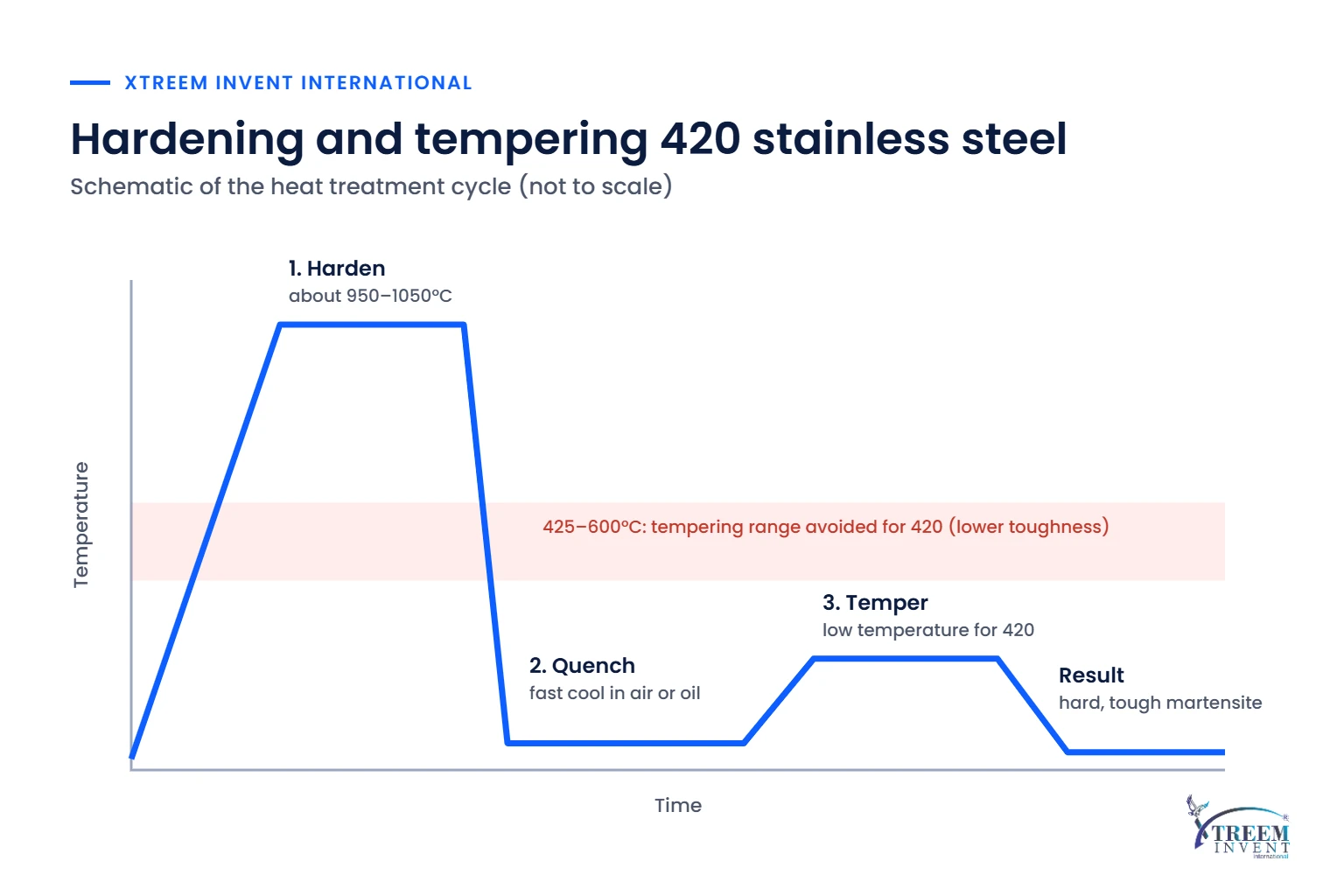
The instrument is heated to roughly 950 to 1050 °C so that the carbon dissolves into the steel, and then it is cooled quickly in air or oil. This quench traps the carbon and turns the structure into martensite, which is very hard but also brittle and full of internal stress. A freshly hardened instrument is not ready to use.
Step 2: Tempering
The instrument is then reheated to a much lower temperature to relieve the stress and trade a little hardness for toughness. The tempering temperature is the main dial the manufacturer turns. ASTM F899 lists typical results: 410 hardened at about 1010 °C and tempered at about 260 °C reaches around 43 HRC, while a higher-carbon 420 hardened at about 1038 °C and tempered at about 149 °C reaches around 58 HRC.
The tempering range to avoid
For 420 stainless steel, tempering between about 425 and 600 °C is avoided because it leaves the steel with low impact resistance. Higher tempering temperatures can also make chromium carbides precipitate, which takes chromium away from the steel around them and weakens its corrosion resistance. Martensitic stainless steel resists corrosion best when it is fully hardened, tempered at a low temperature and well polished.
This is why osteotomes and chisels, such as our anatomic box osteotome and bone osteotomes, depend so heavily on correct heat treatment: they must be hard enough to keep an edge under a mallet, yet tough enough not to chip.
Why carbon content changes the result
Within the martensitic family, carbon is what sets the ceiling on hardness. Standard 420 can be hardened to around 50 HRC, and higher-carbon 420 variants go further. More carbon gives harder, longer-lasting edges but less toughness and slightly lower corrosion resistance. That is why scissors and cutting instruments usually use higher-carbon grades, while forceps, needle holders and parts with box locks and ratchets often use 410 or lower-carbon 420, where toughness and spring matter more than edge retention.
17-4 PH: strength from aging instead of quenching
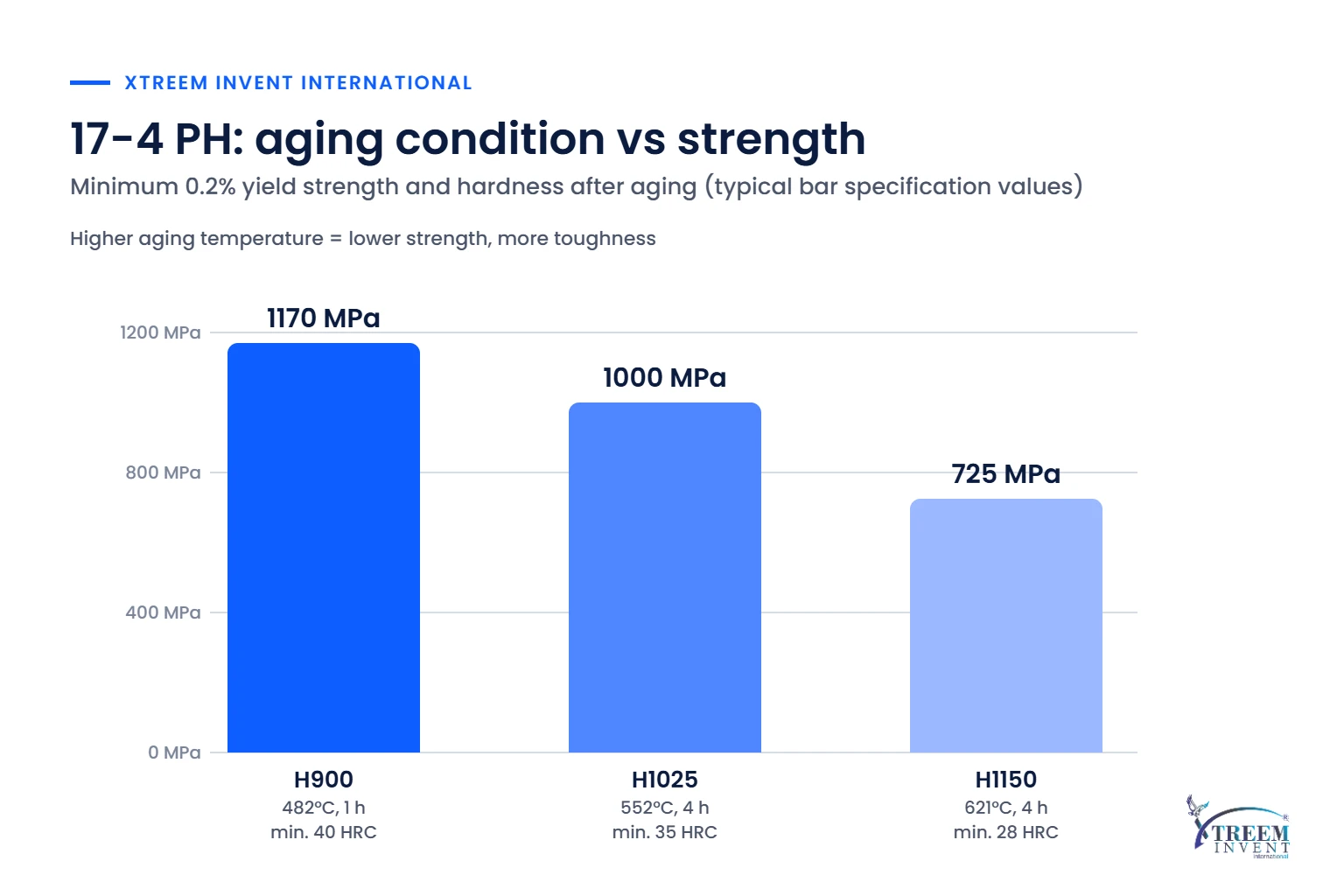
17-4 PH (precipitation-hardening) stainless steel works differently. It is supplied solution-treated (called Condition A) and is then aged at a moderate temperature, which makes tiny copper-rich particles form inside the steel and block deformation. Its corrosion resistance is comparable to 304, which makes it useful for strong parts that also face repeated cleaning and sterilisation.
The surprising part is that a higher aging temperature gives lower strength but more toughness. The condition names come from the aging temperature in Fahrenheit:
| Condition | Aging | Minimum yield strength | Typical hardness | Best for |
|---|---|---|---|---|
| H900 | 482 °C for 1 hour | 1170 MPa | About 40 HRC | Maximum strength and wear resistance |
| H1025 | 552 °C for 4 hours | 1000 MPa | About 35 HRC | A balance of strength and toughness |
| H1150 | 621 °C for 4 hours | 725 MPa | About 28 HRC | Toughness and better resistance to stress corrosion cracking |
Austenitic 304 and 316: heat softens, cold work strengthens
Austenitic grades such as 304 and 316 cannot be hardened by heat treatment at all. They gain strength only through cold working, such as drawing tube or rolling sheet, which is why they are used for retractors, cannulas, suction tubes and trays rather than cutting edges.
Heat still matters for these grades. They are solution annealed at about 1010 to 1121 °C and must then be cooled quickly through the range of roughly 816 to 427 °C. If austenitic steel spends too long between about 450 and 900 °C, for example during welding or slow cooling, chromium carbides form at the grain boundaries. This is called sensitization, and it leaves the steel open to intergranular corrosion. Low-carbon “L” grades such as 316L reduce that risk, which is why they are preferred for welded parts.
What goes wrong when heat treatment is poor
- Too soft (under-hardened or tempered too hot): edges blunt quickly, serrations wear, jaws spring and ratchets slip.
- Too hard (not tempered enough): tips chip or snap, and cracks start at box locks and screw holes.
- Tempered in the wrong range: low impact resistance and earlier rust spots.
- Uneven heating or quenching: warping, so jaws and blades no longer meet properly.
- Scale or a soft surface layer left by the furnace and not fully removed by grinding and polishing, which leads to pitting.
- Rust spots after autoclaving, which can come from carbide precipitation or from iron left on the surface that passivation should remove.
What to ask your supplier
You do not need to be a metallurgist to check that instruments are heat treated properly. Ask any supplier, including us, for these points before you place an order:
- The grade of each instrument or part (for example 410, 420, 17-4 PH, 304 or 316L).
- The hardness range in HRC and how it is checked on finished pieces.
- For 17-4 PH parts, the aging condition (H900, H1025 or H1150).
- Whether the material and heat treatment follow ASTM F899 or ISO 7153-1.
- Whether instruments are passivated after final polishing.
- Material certificates for the steel used in your batch.
If a supplier cannot tell you the grade or the hardness range, treat that as a warning sign. Our guide on how to choose a surgical instrument manufacturer covers the other checks worth making.
Related reading
- How passivation prevents rust in surgical instruments
- German stainless steel vs normal steel
- How to clean and maintain surgical instruments
- Stainless steel surgical instruments manufacturer
- Bone rongeur buying guide
Frequently asked questions
Does heat treatment make all stainless steel stronger?
No. Martensitic grades (410, 420) and precipitation-hardening grades (17-4 PH) become stronger and harder. Austenitic grades (304, 316) cannot be hardened by heat; heating them anneals and softens them, and only cold working makes them stronger.
What do H900 and H1150 mean for 17-4 PH?
They are aging conditions named after the aging temperature in Fahrenheit. H900 (482 °C) gives the highest strength, while H1150 (621 °C) gives lower strength but more toughness and better resistance to stress corrosion cracking.
Can autoclaving undo the heat treatment of an instrument?
Normal steam sterilisation runs at about 121 to 134 °C, which is below the tempering temperatures used for instruments, so it does not undo the heat treatment. Problems after autoclaving are usually corrosion caused by water quality, detergents or poor passivation rather than softening.
Why do some stainless steel instruments still rust?
Stainless steel resists rust because of the chromium in it. Wrong tempering temperatures, sensitization in austenitic parts, iron left on the surface and poor cleaning can all weaken that protection. Correct heat treatment, passivation and good care work together.
What hardness should surgical instruments have?
It depends on the job. Cutting instruments in higher-carbon martensitic grades are usually hardened to around 50 HRC or more, while grasping instruments in 410 can sit in the low-to-mid 40s HRC, as in the ASTM F899 example above. Ask for the specified range and how it is tested.
More guides: see all our surgical instrument buying guides.
Have a question or need a quote? Contact our team.

Chief Executive Officer (CEO)
Zi-Jah Chaudery is the Chief Executive Officer (CEO) at Xtreem Invent, bringing over 20 years of core expertise in the surgical instruments and medical devices manufacturing sector. A visionary leader in international trade and global B2B healthcare exports, he specializes in supply chain management, compliance, and international quality standards. Under his leadership, Xtreem Invent connects premium Pakistani manufacturing with healthcare facilities worldwide.